
The Margin of Error: Why Investigation Efficiency Has Become a Margin Decision
Table of Contents
Manufacturing is entering 2026 with rising input costs, tighter schedules, and a sharper economic penalty for repeat defects. In this environment, investigation efficiency in quality, process, and operations engineering has stopped being a back-office metric and become a margin decision.
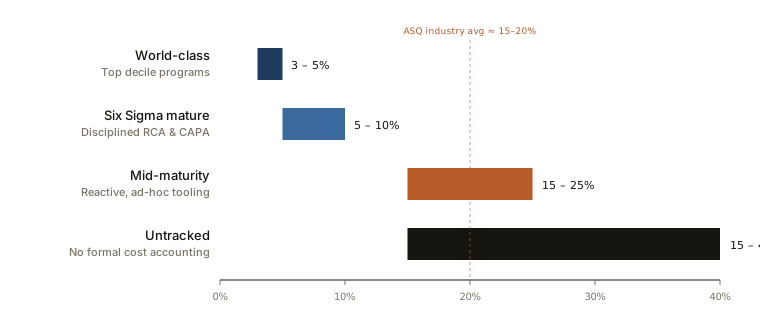
Cost of Poor Quality is widely understated. COPQ typically runs 15–40% of revenue in plants that have never measured it systematically; world-class operations sit at 3–5%. Each percentage point recovered from quality failure is mathematically equivalent to a point recovered from any other cost line.
Investigations spend most of their hours on data assembly, not analysis. Roughly half of investigation time is consumed reconstructing context across systems that weren't designed to work together — before the first useful "why" can be asked.
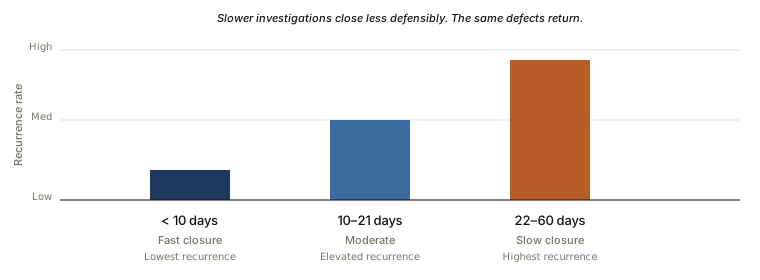
Slow closure compounds. CAPA processes that close in over three weeks have measurably higher recurrence rates than those closed in under ten business days. Each unresolved cause becomes a latent failure mode waiting for a triggering condition.
The Operating Environment Has Changed
Manufacturing is entering 2026 in a posture it hasn't held since the early 2010s: cautious, disciplined, and acutely aware of the compounding cost of small mistakes. Raw material prices rose an average of 5.4% across 2025 and are projected to rise another 4.4% in 2026. 1[1]Institute for Supply Management (ISM), Manufacturing Forecast Survey, December 2025. Raw material prices increased 5.4% in 2025; projected 4.4% increase for 2026. Tariff-related cost increases have added an estimated 2 to 4.5 percentage points to factory operating expenses across the sector, with some mid-sized electronics manufacturers reporting year-over-year component cost increases of roughly 12%. 2[2]Markovate, Tariff Impact on Manufacturing Operations, February 2026. Tariff-related cost increases estimated at 2–4.5% of factory operating expenses; mid-sized electronics firms reported approximately 12% year-on-year component cost increases. Average industry capacity utilization sits at 79.2%, well below historical norms, even as input costs continue to climb. 3[3]ISM, Manufacturing Semiannual Forecast, May 2025. Manufacturers operating at average 79.2% of normal capacity.
In this environment, productivity isn't a slogan. It's a survival mechanism.
The U.S. manufacturing sector shed roughly 68,000 jobs over the course of 2025, the steepest annual loss since the 2020 contraction, and the trend continued into early 2026 with another 12,000 jobs lost in February alone. 4[4]U.S. Bureau of Labor Statistics, Employment Situation, January 2026; KPMG Economic Outlook, December 2025 jobs report. Manufacturing sector lost approximately 68,000 jobs during 2025; further losses through Q1 2026. At the same time, two-thirds of plants surveyed by ABB report unplanned downtime at least once per month, and Siemens estimates that the world's 500 largest manufacturers lose roughly $1.4 trillion annually to unplanned downtime, approximately 11% of total revenues, up from 8% in 2019–2020. 5[5]ABB, Value of Reliability Report, 2024 survey of 3,200 plant maintenance leaders globally. 6[6]Siemens, The True Cost of Downtime 2024. Fortune Global 500 lose approximately $1.4 trillion annually to unplanned downtime, about 11% of revenues, up from 8% in 2019–2020. The cost of an idle hour is now roughly 50% higher than it was six years ago. 7[7]TeamSense / Siemens analysis, 2026. Hourly cost of unplanned downtime is approximately 50% higher in 2025 than in 2019.
Against this backdrop, the work of quality engineering, process engineering, and operations has changed in character. The teams responsible for investigation, root cause analysis, and corrective action are no longer simply protecting compliance posture. They're protecting margin. And in many organizations they're doing so with fewer hands, tighter deadlines, and more brittle supply chains than they had two years ago.
The Hidden Math of Poor Quality
The Cost of Poor Quality (COPQ) is one of the most consistently understated numbers on the manufacturing P&L. The American Society for Quality benchmarks show that quality-related costs typically account for 15 to 20% of annual sales for manufacturers, and that the hidden costs of poor quality often exceed the visible costs by a factor of four. 8[8]American Society for Quality (ASQ), Cost of Quality benchmarks. Quality-related costs at 15–20% of annual sales; hidden costs exceed visible costs by approximately 4x. Independent analyses place the typical range at 10 to 30% of revenue, with world-class manufacturers achieving below 5%. 9[9]Learn Lean Sigma, Manufacturing Quality Statistics, 2026; Quality Digest, COPQ analysis. COPQ typically 10–30% of revenue for manufacturers; world-class achieves below 5%.
The reason COPQ is so consistently understated is structural. The costs are scattered across departmental ledgers: scrap sits in manufacturing, warranty in finance, premium freight in logistics, customer credits in sales, and the quality-engineer hours burned on investigation reports rarely sit anywhere at all. 10[10]Symestic, Cost of Poor Quality (COPQ): Definition and Examples, 2025; analysis derived from ISO 22400 and Juran benchmarks. COPQ typically 15–40% of revenue in mid-maturity plants and 5–10% in Six Sigma mature operations; commonly under-measured because costs sit across multiple departmental ledgers. When COPQ is reconstructed across the full set of accounts, the numbers are jarring. Plants that have never measured COPQ systematically usually land at 15 to 40% of revenue. Mature Six Sigma environments push it below 10%. World-class operations run at 3 to 5%.
For a manufacturer running 35% gross margin and 20% EBITDA margin, a 5-point gross margin compression (from any combination of tariffs, rework, and recurrence) translates to roughly a 25% reduction in operating profit on the same revenue. 11[11]BB Financial Services, How Tariffs Impact Margin Forecasting in 2026, March 2026. A 5-point gross margin compression on a 35% / 20% gross / EBITDA structure produces approximately a 25% reduction in operating profit on the same revenue. Each percentage point recovered from quality failure is mathematically equivalent to a point recovered from any other cost line. It just tends to be quieter, and it tends to take longer to find.
Where the Investigation Hour Actually Goes
If COPQ reflects the cost of failure, investigation cycle time reflects the speed at which that cost stops accumulating. The two are linked. A defect's economic impact is bounded only by how long it takes to find, contain, and eliminate the cause.
In practice, root cause investigations for significant failures take 2 to 5 business days from initiation to corrective action plan, with complex multi-factor investigations on safety-critical or regulated systems often running considerably longer. 12[12]Oxmaint, Root Cause Analysis in Maintenance, March 2026. Significant-failure RCA typically 2–5 business days; complex multi-factor investigations on safety-critical systems run longer. Documentation, supplier coordination, and verification testing routinely stretch the closure window to several weeks, particularly in pharmaceutical, medical device, and aerospace contexts.
What is less visible is how that time is spent. The largest single line item in any investigation is rarely analysis. It's assembly: the manual reconstruction of context across systems that weren't designed to work together. Batch records sit in one system, sensor data in another, inspection notes in email threads, supplier certifications in a SharePoint folder, and operator observations in handwritten logbooks. Before a quality engineer can ask the first useful "why," they have to spend hours, sometimes days, answering "what."
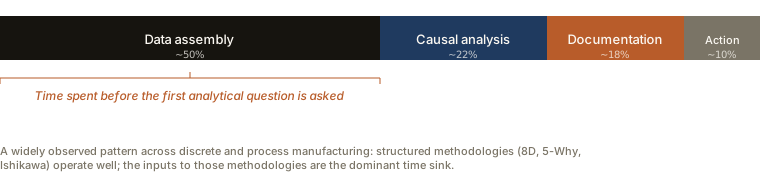
This pattern is well-known to anyone who has run an 8D or led a CAPA. The structured methodologies are sound; the inputs to them are the bottleneck. When a senior quality engineer spends most of an investigation pulling data and writing it up, only a fraction of their hours are left for the cognitive work the role was designed for. 13[13]Monte Carlo, 2022 Data Quality Survey. Practitioners report that approximately 40% of working time is spent evaluating or assembling data inputs prior to analytical work; used here as a directional analog for time spent assembling investigation inputs in adjacent technical domains.
This is the quiet form of capacity erosion. It doesn't appear on a payroll line. It shows up only in the count of investigations a team can credibly close in a given quarter, and in the recurrence rate of the ones they did.
The Compounding Cost of Slow Closure
Recurrence is where the math becomes uncomfortable. Investigations that close quickly, with a defensible causal model, suppress recurrence. Investigations that close slowly, or that arrive at the wrong cause under deadline pressure, do not. CAPA processes that take three weeks or longer have measurably higher recurrence rates than those completed in under ten business days. 14[14]Kissflow, Fixing CAPA Delays in Manufacturing with BPM Workflow Automation, 2026. CAPA processes taking three weeks or longer have measurably higher recurrence rates than those completed in under ten business days.
The downstream effect isn't subtle. Aberdeen Group benchmarking shows that organizations with effective CAPA systems achieve a 1.5x higher on-time delivery rate, an approximately 5% higher gross margin, and a 10% reduction in overall quality costs compared to peers without one. 15[15]Aberdeen Group, CAPA effectiveness benchmarking, as cited in industry analyses. Organizations with effective CAPA systems are reported to achieve approximately 1.5x on-time delivery, a 5% higher gross margin, and a 10% reduction in overall quality costs versus peers without one. These differences aren't driven by any single technology or methodology. They're driven by the rate at which the same defect, once investigated, fails to return.
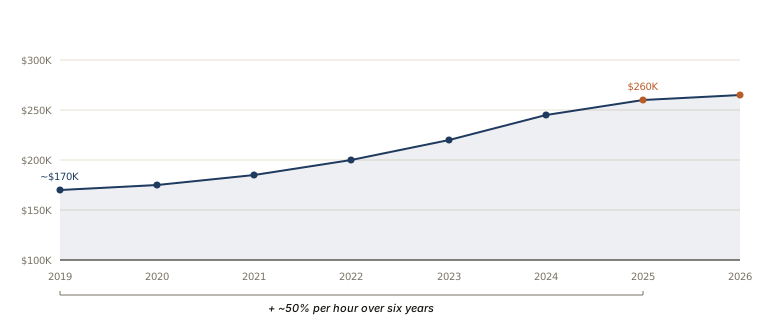
In an environment where a single hour of unplanned downtime costs an average manufacturer roughly $260,000, and an automotive plant approximately $2.3 million, the difference between a 12-week and a 4-week investigation cycle isn't a back-office metric. 16[16]Aberdeen Research / Sumitomo Drive analysis, 2025. Average manufacturing downtime cost approximately $260,000 per hour. 17[17]Erwood Group / Arda industry estimates, 2025. Automotive sector downtime approximately $2.3 million per hour. It's a P&L line.
There's a further consequence. Each unresolved or partially resolved root cause becomes a latent failure mode: a defect waiting for a triggering condition. As supply chains shift, materials substitute, and process parameters drift in response to cost pressure, those latent modes are increasingly likely to surface. The very dynamics squeezing margin are also activating the long tail of past investigations that closed without conviction.
The investigations are going to happen either way. The only question is what fraction of the team's hours will be spent solving versus searching.
Efficiency as Strategic Capacity
The conventional response to investigation backlog is to add headcount. In 2026 that response is largely off the table. Manufacturing employment is declining, hiring is slow, and the quality and process engineering roles required to close complex investigations are among the hardest to fill. 18[18]U.S. Bureau of Labor Statistics, Q1 2026; National Association of Manufacturers vacancy benchmark, Q3 2025. Average manufacturer reports 4.2% of positions unfilled; nearly one in four reports vacancy rates above 5%.
The alternative is to recover capacity from the existing team: to convert hours currently spent on data assembly into hours spent on judgment. The arithmetic is straightforward: if a quality engineer spends roughly half of investigation time gathering inputs, halving that fraction recovers approximately a quarter of their working capacity without adding a single role. Across a team of ten engineers, that recovery is the equivalent of two to three additional engineers, at no incremental headcount cost and at a fraction of the time-to-productivity of a new hire.
This isn't a tooling argument. It's a capacity argument. Three operational shifts compound the leverage available to a quality function in the current environment:
Integrated context. When batch records, sensor data, inspection notes, and supplier documentation can be assembled into a single investigation timeline without manual reconstruction, the front half of the investigation collapses. The team can begin causal analysis on day one rather than day three.
Correlation across history. Most plants have, sitting in their archives, the answer to most of their recurring problems, buried in past 8Ds and CAPAs that no one has time to read. When prior investigations are searchable and structured, a new defect can be triaged against the full history of similar failures rather than re-investigated from scratch. Institutional knowledge stops walking out the door with retirements.
Defensibility. Investigations produced under deadline pressure tend to fail audit, regulatory review, and supplier escalation in predictable ways. Those that capture the full causal chain, with traceability back to source data, tend to hold. In regulated sectors like medical devices, pharmaceuticals, advanced mobility, and semiconductor, the cost of an indefensible investigation can exceed the cost of the original defect by an order of magnitude.
Investigation efficiency isn't a quality metric in 2026. It's a financial one. The function that closes investigations faster, without losing defensibility, protects more of the margin that the rest of the business is fighting to preserve.
A Note on Capability
We built Lattice because we believe the work of investigation is too valuable to be spent on data hunting. But the case for investigation efficiency is older than any platform, and it doesn't require ours to be true.
The engineers and operators running quality programs in 2026 are working under tighter constraints than they did even two years ago. They're being asked to investigate more defects, with thinner staffing, against tighter regulatory expectations, in supply chains that are still re-stabilizing. The most consequential thing an organization can do for them isn't exhortation. It's the removal of the structural friction that's consuming their hours.
That removal, however it's achieved, has a measurable financial signature: lower COPQ, fewer recurring defects, faster CAPA closure, and a quality function that scales with output rather than against it. It's one of the few cost levers in the current environment that compounds rather than depletes. And in a year where most levers do the opposite, that distinction matters.
The Closure Bias Problem: Why root cause investigations close on the most administratively convenient cause rather than the most accurate one. Read more →
References
- Institute for Supply Management (ISM), Manufacturing Forecast Survey, December 2025.
- Markovate, Tariff Impact on Manufacturing Operations, February 2026.
- ISM, Manufacturing Semiannual Forecast, May 2025.
- U.S. Bureau of Labor Statistics, Employment Situation, January 2026; KPMG Economic Outlook, December 2025 jobs report.
- ABB, Value of Reliability Report, 2024 survey.
- Siemens, The True Cost of Downtime 2024.
- TeamSense / Siemens analysis, 2026.
- American Society for Quality (ASQ), Cost of Quality benchmarks.
- Learn Lean Sigma, Manufacturing Quality Statistics, 2026.
- Symestic, Cost of Poor Quality (COPQ): Definition and Examples, 2025.
- BB Financial Services, How Tariffs Impact Margin Forecasting in 2026, March 2026.
- Oxmaint, Root Cause Analysis in Maintenance, March 2026.
- Monte Carlo, 2022 Data Quality Survey.
- Kissflow, Fixing CAPA Delays in Manufacturing with BPM Workflow Automation, 2026.
- Aberdeen Group, CAPA effectiveness benchmarking.
- Aberdeen Research / Sumitomo Drive analysis, 2025.
- Erwood Group / Arda industry estimates, 2025.
- U.S. Bureau of Labor Statistics, Q1 2026; National Association of Manufacturers vacancy benchmark, Q3 2025.