The Closure Bias Problem: Why Root Cause Investigations Fail
Table of Contents
Across fifteen years of operating in hardware quality, a single structural weakness recurs: quality systems structurally optimize for closure rather than understanding. This "closure bias" creates a gravitational pull toward administratively convenient root causes, producing recurring failures and organizational risk.
Closure bias systematically favors the most closable root cause (like retraining) over the most accurate one (systemic redesign).
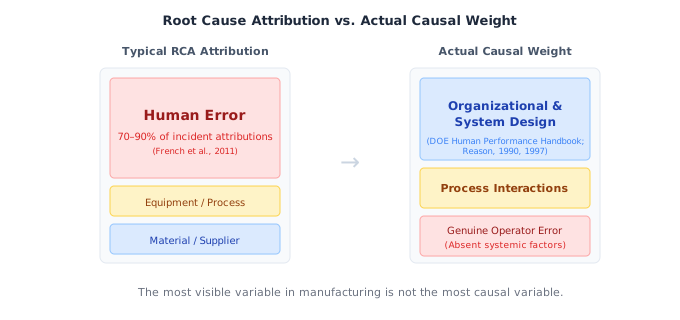
Operator error is overattributed because operators are the most visible variable in the system, not the most causal one.
Diagnostic debt, the accumulated cost of incomplete investigations, compounds over time and produces recurring nonconformances.
How Closure Bias Manifests in Practice
Across fifteen years of operating in hardware quality, from defense primes running hundreds of automated machines under military specification, through FAA certification campaigns for novel aircraft, to standing up quality management systems at early-stage companies, a single structural weakness recurs. It is not a failure of effort or competence. It is a failure of optimization target.
Quality systems optimize for closure rather than understanding.
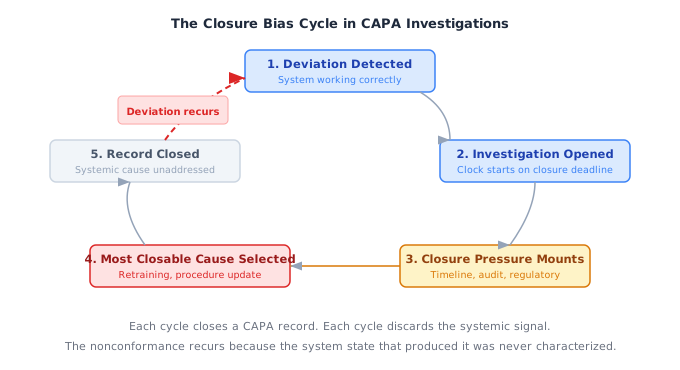
The corrective action must be written. The nonconformance must be dispositioned. The CAPA must close within the timeline. These are legitimate imperatives. But they create a gravitational pull toward the most closable root cause rather than the most accurate one. A root cause resolved with retraining closes in five days. One requiring cross-functional process redesign closes in five months, if it closes at all.
This paper documents how closure bias manifests across environments spanning cleanroom microelectronics, unmanned aerial systems, experimental aircraft certification, advanced energy systems, and international contract manufacturing, and arrives at the same diagnostic failure point every time. The investigative methods embedded in modern quality management (5-Why analysis, Ishikawa diagrams, linear CAPA workflows1[1]These methods are codified in regulatory and industry frameworks including ISO 9001:2015, IATF 16949, AS9100, and 21 CFR 820.90/820.100. Their dominance reflects regulatory expectation rather than demonstrated diagnostic superiority for multi-factor failure modes.) are structurally mismatched to the systems they are asked to diagnose.
The most dangerous defect in any quality system is not the one that escapes detection. It is the one that is detected, investigated, and attributed to the wrong cause.
Closure Bias: Why CAPA Investigations Optimize for the Wrong Outcome
The pattern is consistent across organizational maturity levels. In large defense programs with architecturally complete quality infrastructure (Material Review Boards, supplier corrective action workflows, hundreds of controlled work instructions), closure bias takes the form of investigation by disposition.2[2]Reason, J. (1997). Managing the Risks of Organizational Accidents. Ashgate Publishing. Reason identifies the distinction between individual accidents and organizational accidents arising from latent systemic conditions. The question shifts from "Why did this fail?" to "How do we disposition this nonconformance to maintain schedule?" The record is complete; whether the corrective action addresses the actual failure mechanism is a question the system does not structurally verify.
At the other extreme, early-stage hardware companies building their first quality management system face a different version of the same problem. The quality engineer is simultaneously constructing the system and operating within it, conducting PFMEA retroactively on processes already in production, writing inspection criteria for assemblies already shipping. Only the most visible failures get investigated. Chronic, systemic issues remain invisible because the infrastructure to observe them does not yet exist.
In both cases, the mature, heavily-documented program and the startup with no documented history, the result converges. Recurring nonconformances, attributed to different proximate causes each cycle, because the systemic driver was never surfaced in any individual investigation. The environments could not be more different. The diagnostic failure mode is identical.
When Environmental Failures Disguise Themselves as Random Events
Electrostatic discharge (ESD) damage in electronics manufacturing provides the clearest case study of closure bias in action. In one production environment observed directly, an electronics assembly operation sustained a persistent ~25% failure rate during functional testing across multiple production lots over several months. Each failure showed damage consistent with electrostatic discharge, but the instances appeared random, distributed across different components, board locations, operators, and shifts with no discernible pattern in the per-incident data.
The closure-biased investigation proceeds predictably. Each failure is investigated individually. Corrective actions are written: retrain the operator, replace a grounding strap, add an ionizer. Each CAPA closes. The failure rate does not change because each investigation closes its record without characterizing the electrostatic environment that produces the failures.
The failure is not in any individual operator or workstation. It is in the system's aggregate configuration. The resolution, demonstrated in practice, requires treating ESD as an environmental control program: an integrated system of grounding infrastructure, humidity control, material specifications, training curricula, packaging standards, and process sequencing designed as a single coherent intervention.
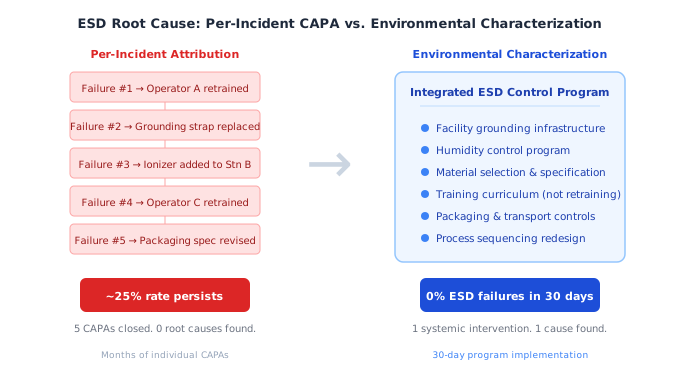
The result: 25% failure rate to zero ESD-related failures within 30 days.3[3]Operational data from the author's direct practice in electronics manufacturing quality management. The ESD control program encompassed facility grounding, humidity control, material specification, training curriculum redesign, packaging controls, and process sequencing. This is the archetype for a large class of manufacturing failures: problems that present as random individual events but are deterministic consequences of the system's aggregate configuration. Closure bias, by investigating each incident in isolation, is structurally blind to configurational failure modes.
The Structural Limit of Supplier Corrective Actions
Across every manufacturing paradigm observed (defense, aviation, energy, electronics), supplier quality is where closure bias is most consequential, because it compounds with an information asymmetry that the standard corrective action framework does not resolve.
Modern supplier quality programs have made progress here. Joint audits, shared quality dashboards, supplier portals, and co-located quality engineers all narrow the gap. But these mechanisms primarily address compliance visibility, confirming that the supplier's quality system meets requirements. They do not provide the investigative access needed for real-time diagnostic reasoning: the ability to correlate the customer's downstream failure signature against the supplier's process parameters, environmental conditions, and equipment telemetry at the time of manufacture. The quality team's investigative authority, in practice, still ends at the company's walls.
The result: the engineer receives the supplier's root cause explanation, evaluates it for plausibility, and either accepts or escalates. The actual failure investigation occurs inside the supplier's operation, outside the customer's diagnostic visibility. The customer sees the failure; the supplier sees the process; neither sees both simultaneously.
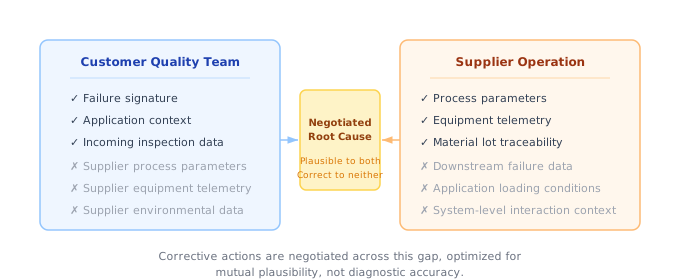
The interventions that work share a common structure: they collapse the asymmetry. Implementing joint automated testing at one circuit board supplier, designed against the customer's downstream failure signatures, produced a 29% immediate defect reduction. At another sole-source supplier with a 60% reject rate over three years, a jointly executed performance improvement program achieved >95% acceptance in 60 days. Three years of individual corrective action requests had not resolved the problem. Sixty days of shared investigation did.4[4]Operational data from the author's direct practice in supplier quality management. The 29% defect reduction resulted from implementing automated electrical testing at a printed circuit assembly supplier. The 60% to >95% recovery resulted from a structured performance improvement program jointly executed with a sole-source hardware supplier.
Why Operator Error Is Overattributed in Root Cause Analysis
Across every paradigm, one root cause attribution dominates the corrective action record: operator error. In the investigations surveyed here, spanning over a decade of CAPA records across defense, aviation, energy, and electronics manufacturing, this attribution was the correct and complete explanation in a minority of cases. More often, it reflected the visibility of the operator rather than the weight of their causal contribution.
The pattern: an operator performs a manual process thousands of times without incident. On one occasion, it fails. The investigation confirms training, notes the deviation, and attributes the failure to the operator. The CAPA is retraining. What this investigation does not ask: what changed in the system to make this error trajectory accessible?
Human error rates are predictable functions of task design, environmental conditions, time pressure, cognitive load, and procedural clarity.5[5]Reason, J. (1990). Human Error. Cambridge University Press. See also: Reason, J. (2000). Human error: models and management. Reason distinguishes between the person approach and the system approach. In the investigations reviewed, operators were disproportionately attributed because they are the most visible variable: easy to observe, easy to document, and easy to "correct." The systemic factors that made the error possible require deeper investigation that the standard toolkit does not incentivize.
When human performance is measured by the conditions under which operators work, not just first-pass yield, measurable improvements follow. In one implementation, a performance indicator dashboard tracking technician working conditions produced a 10% improvement in first-pass yield through task and environment redesign, not retraining.6[6]Operational data from the author's direct practice in manufacturing quality management. Yield improvement was attributable to task and workstation redesign informed by environmental stressors and task design metrics data.
Diagnostic Debt: The Compounding Cost of Incomplete Investigations
Software engineering uses technical debt7[7]Cunningham, W. (1992). The WyCash Portfolio Management System. Cunningham introduced the "technical debt" metaphor to describe the accumulated cost of expedient software design decisions. for the accumulated cost of expedient shortcuts. Hardware quality has an analog: diagnostic debt. Every root cause investigation that closes with an inaccurate attribution generates it. The CAPA record shows "resolved." The system state persists. The next occurrence generates a new investigation, which arrives at a different proximate cause and closes again. The debt compounds.
The operational signatures of high diagnostic debt are consistent across every manufacturing paradigm observed:
- Recurring Nonconformances With Rotating Root Causes: The same failure mode appears repeatedly, attributed to different proximate causes each time. The CAPA record shows multiple "resolved" investigations; the defect rate remains unchanged. This is the clearest signal that the actual system state was never characterized.
- Corrective Action Inflation: Over time, corrective actions become increasingly conservative: tighter tolerances, additional inspection points, more retraining. Each adds cost without addressing the underlying mechanism. The process becomes less efficient as compensating controls accumulate around an undiagnosed cause.
- Expertise Concentration Risk: When the formal quality system cannot reliably diagnose failures, organizations default to their most experienced engineers. Diagnostic capability concentrates in a small number of practitioners whose departure represents material operational risk. The organization's investigative capability becomes coupled to individual tenure rather than institutional infrastructure.
The compounding nature of diagnostic debt explains a pattern that frustrates quality leaders: the organization that invests in more documentation, more inspection points, and more training often sees diminishing returns. The investment addresses the symptoms of diagnostic failure (escaped defects, audit findings) without addressing the mechanism (closure-biased root cause attribution).
The Investigation Gap: Our analysis of 417 FDA Warning Letters found that 48% cited inadequate root cause investigation. Read more →
What AI-Assisted Root Cause Investigation Changes
The patterns above share a common failure mode despite spanning different products, regulations, and organizational maturities. The failure is not in quality professionals, who are competent and dedicated in every environment described, but in the structural mismatch between the tools available and the systems those tools must diagnose.
Lattice resolves that mismatch through the Conductor, an AI reasoning engine that investigates every deviation with the same systematic rigor regardless of severity or timeline. It does not triage based on administrative convenience. It does not default to operator error. It does not fatigue across shifts or lose institutional memory across personnel changes.
The Conductor evaluates the system state that made the failure trajectory accessible, integrating process data, environmental telemetry, operator narratives, and historical investigation records.
Against closure bias itself, the system eliminates the structural incentive that produces it. The Conductor does not optimize for the most closable explanation. It maps the full topology of the failure space and identifies the interventions most likely to shift the system away from failure, whether that means tightening a tolerance, redesigning a task, or restructuring a supplier relationship.
The quality engineer's judgment is not the problem. The quality engineer's judgment, unsupported by systems that match the complexity it is asked to diagnose, is the problem. Lattice provides the support.
The result is investigations that close because the cause has been found, not because the timeline has expired. Investigations that hold up under regulatory scrutiny because they are comprehensive, traceable, and governed by physical reasoning rather than administrative convenience.